美股跌到位了吗?· 7.20-7.24 本周回顾
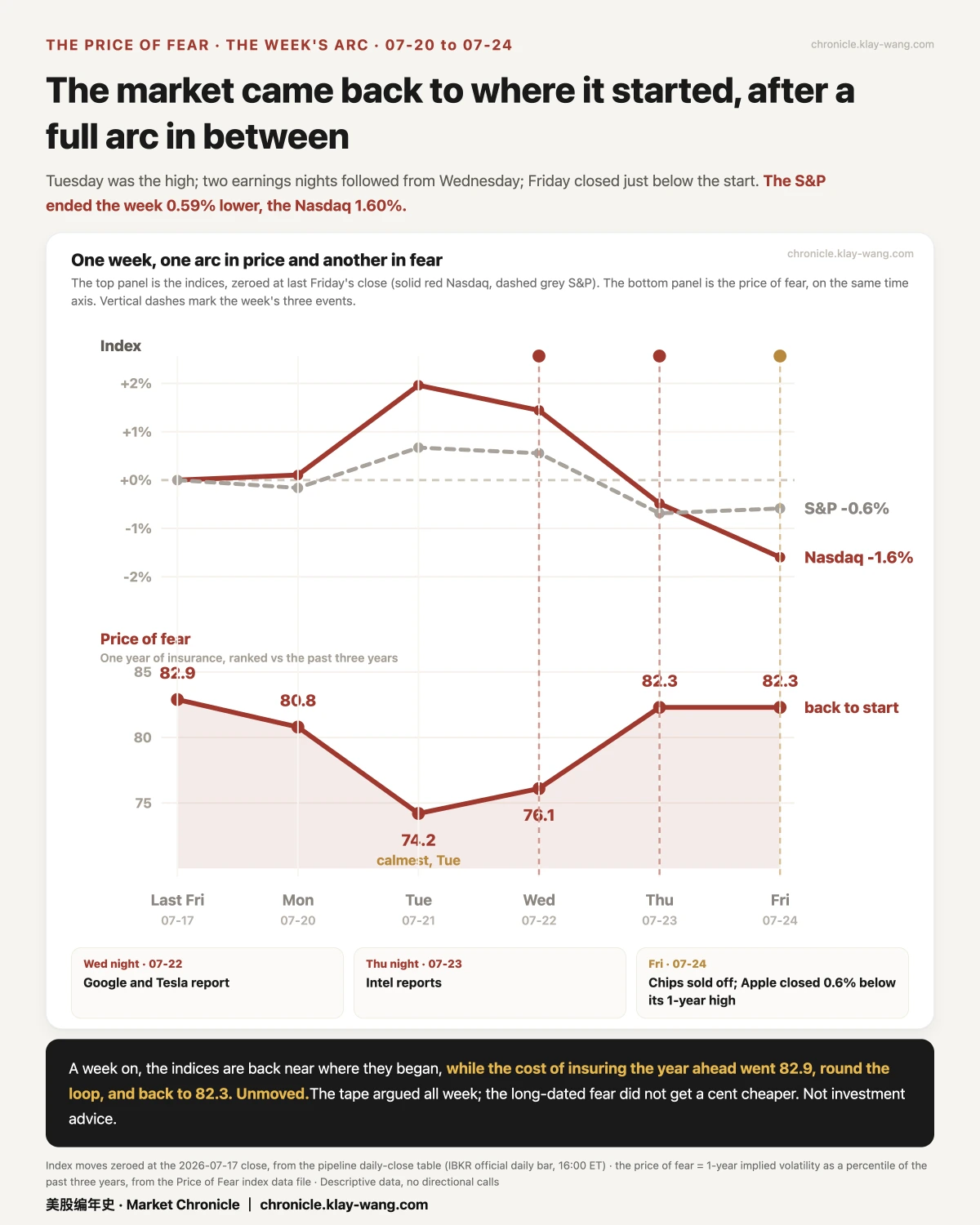
• 跌到位了吗:我不猜。但市场这周出了这么大的事故,明年的保费却只动了 1.9%:卖保险的人,没把这周当变天
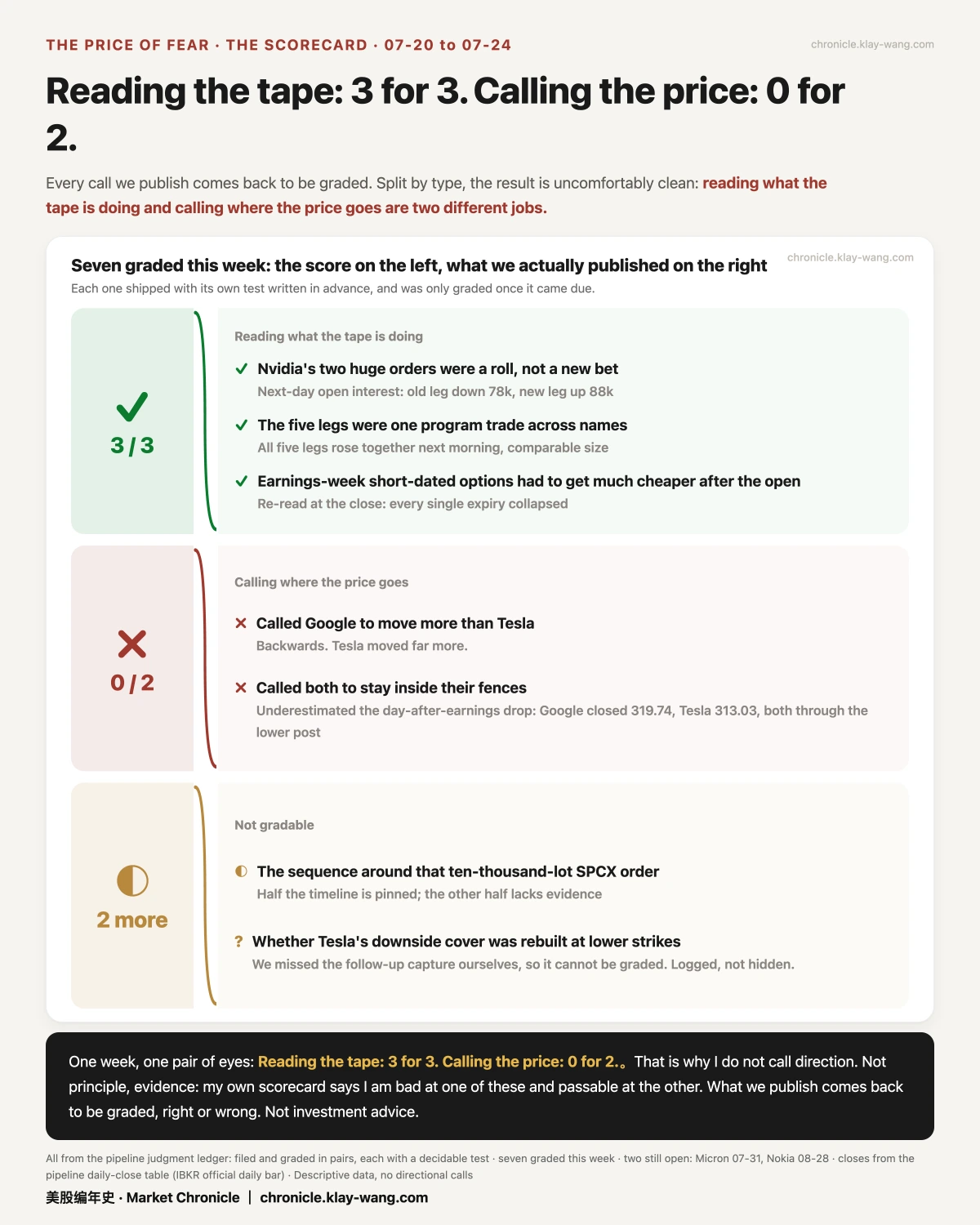
• 本周对账:发过的判断开奖 7 条,对 3 错 2。两个错是同一个错:低估了财报第二天的跌幅
• 下周两颗雷同一晚:美联储决议撞上 Meta 财报。市场给 Meta 的围栏 ±8.01%,苹果的两倍宽
📒 本周回顾:哪些对了,哪些错了
一句话:发过的判断,对了回来对,错了也回来认。
先说错的。
周三那封《财报开牌前,聪明钱在买翅膀》里,我们押了两条:谷歌财报之夜会比特斯拉动得大;两只都不会冲出市场赛前划好的波动带。
第一条,错。实际是特斯拉动得大。
第二条,财报当晚看起来对了:两只都乖乖待在带内。但第二天,特斯拉 −14.5%,谷歌 −7.1%,到周五收盘双双跌穿带子下沿(谷歌收 319.74,带下沿 329.17;特斯拉收 313.03,下沿 359.85)。也错。
两个错其实是同一个错:财报的账单,是第二天才付的。我们把当晚的带子,当成了整段行情的围栏。
再说对的。三条,全是同一类。
英伟达那笔约 3 亿美元的大单:我们周三当天判断是老仓搬家、不是新赌注(判断台账 07-22 当天立案,先写判断,后看开奖),并且把第二天该看到的两个数字提前写下来:旧仓应减约 8 万张,新仓应增约 8.8 万张。第二天开奖:−78471 和 +88009。两个数都对上了。
三巨头同一天各冒出 1.1 万张的五条腿:我们判断是同一家机构的程序单。第二天五条腿的持仓齐刷刷各增约 1.1 万张。
财报周被炒到天价的短期期权,开盘后必然大幅泄气:最狠的一只,一夜从 100 上下泄到 41。
本周回顾:猜价格往哪走,0 对 2;看懂这笔钱在干什么,3 对 3。我们不猜牌,我们看筹码。
🙋 问得最多的两个问题
一句话:我不预测价格,但钱的每个动作都记了账。
跌到位了吗?
不知道,也不猜。但这一周有三笔钱的动作,值得你知道。
第一笔:保险没涨价。 你的车要是出了事故,第二年续保,保费多半要涨:保险公司认定这条路以后还会出事,才敢多收钱。这一周市场天天挨打,短期的怕上蹿下跳,来回跑了 12.4%;可给未来一年买保护的价钱,全周只动了 1.9%。出了事故,保费却没涨。 卖保险的是全市场最会算账的一批人:他们没提价,意思是在他们的账本上,这一周是一场事故,不是路况变了。你纠结割肉还是加仓的那一刻,这个数不告诉你该怎么做;它只告诉你:天天跟恐惧做买卖的那批人,这周没改价。
第二笔:有人押会动,不押方向。 有人在 8 月底到期的合约上花了五六百万美元,同时买涨和买跌,两边距离现价对称。这笔单 99% 留仓过夜,是真仓;到期日正好罩住下周的美联储会议和整个财报季。
第三笔:极端的险有人上。 周一有人花一万二美元,买了 3000 张 SPY 跌 86% 才赔的保险,4 美分一张。第二天几乎全部留仓。
三笔连起来读:主流的钱没在慌,会动的钱在加价,极端的险一直有人买。 这不是预测,是记账。
存储还跌吗?
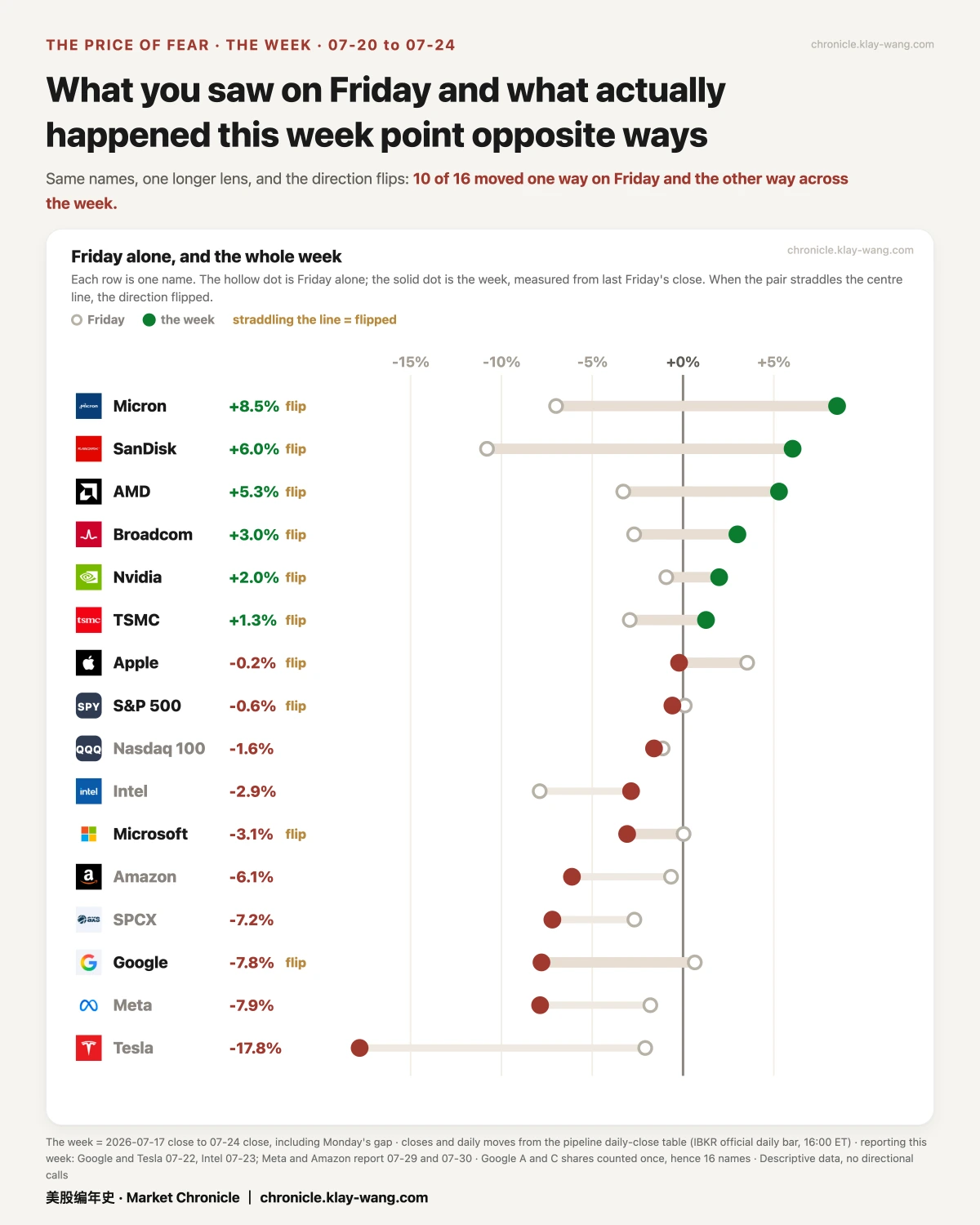
先把一个反直觉的事实放正:周五被血洗的存储,其实是本周最强的板块。 美光这一周 +8.5%(周五 −7%),闪迪 +6%(周五 −10.8%)。周五吐回去的,少于这一周涨出来的。
然后看钱怎么动的:
• 周三收盘前最后半小时,有人花约 1 亿美元买了美光的看涨,这笔单赚钱的门槛是月底站上 996。周五美光收 920.95,低于那道门槛 75 美元。下周五开奖,赢输我们都晒。
• 周五大跌当天收盘前,又有人花 960 万美元,买美光回到 1000 的票。跌下来的当天,就有钱进场赌反弹。
• 但想上车的先看票价:买它们期权的成本,闪迪排在过去一年的 96 分、美光 88 分(100 分就是这一年最贵那天)。便宜的是股票,不是上车的成本。
• 长期的票价没慌:闪迪一年多之后到期的期权价格,一周从 118 降到 114,还在轻微降温。
钱的表态翻译成一句:短线在对赌,长线没改主意,入场费仍在最贵档。
🗓 下周看点:钱已经表态的两场
一句话:我不猜结果,只报市场已经付钱买下的预期。
第一场:Meta 财报,周三盘后,同一晚撞上美联储决议。一晚两颗雷。
钱的表态:市场给它划的围栏 ±8.01%(558 到 655 美元),四家巨头里最宽,是苹果(±3.9%)的两倍。翻译:市场为 Meta 准备了全场最大的意外空间。微软同晚开牌,围栏 ±6.62%。
周四苹果、亚马逊接棒。亚马逊的账本歪着:押它涨的持仓是押跌的 3.4 倍。每张合约都有买方和卖方,这个倍数不代表谁会赢,只代表如果结果朝反方向走,被打脸的人多得多。
第二场:存储的两次终审。
周五 07-31:美光那张 1 亿美元大单开奖,996 见分晓。
08-05:闪迪财报。到时候它 96 分的票价,就要接受检验。
我们的挂账(美光 07-31、诺基亚 08-28)到期都会回来对,赢输都晒。
这封信不告诉你该怎么做。它只保证一件事:我们说过的每句话,都会回来对账。
• Done falling? We don't guess. But after a week of hits, the price of one-year insurance moved just 1.9% — the people selling protection didn't reprice the road
• This week's scorecard: 7 calls settled — 3 right, 2 wrong. Both misses were the same miss: earnings bills come due the next day
• Two grenades, one evening: the Fed and Meta report on the same night. Meta's fence is ±8.01%, twice as wide as Apple's
📒 The scorecard: what we got right, what we got wrong
One line: every call we publish comes back for settlement — wins and losses alike.
The misses first.
On Wednesday we made two calls: Google would move more than Tesla on earnings night, and neither would break out of the range the market had priced in.
First call: wrong. Tesla moved more.
Second call looked right that night — both stayed inside their bands. Then came the next day: Tesla −14.5%, Google −7.1%, and by Friday's close both had fallen through the bottom of their bands (Google closed 319.74 vs. a floor of 329.17; Tesla 313.03 vs. 359.85). Wrong again.
Both misses are the same miss: earnings bills come due the next day. We mistook one night's range for the whole ride's fence.
And one piece of homework we failed: a call required checking open interest before Friday's open. We missed the window; the contracts expired and settled to zero. Permanently unverifiable. Logged as cannot-judge. No excuses.
Now the hits. Three, all the same kind.
That roughly $300M Nvidia print: we called it a position moving house, not a new bet — logged the same day, judgment first, verdict later — and wrote down the two numbers the next morning should show: old position down ~80k contracts, new one up ~88k. The verdict: −78,471 and +88,009. Both matched.
Five legs of ~11.2k contracts each, across three mega caps, in one day: we called it one institution's programmed trade. Next morning, all five legs' open interest rose in lockstep.
Earnings-week options priced at absurd levels must deflate at the open: the worst one went from around 100 to 41 overnight.
The scorecard in one line: guessing where prices go, 0 for 2. Reading what the money is doing, 3 for 3. We don't guess cards. We count chips.
One more confession: we also cited a wrong closing price this week (an after-hours print instead of the official close). The ledger now carries a dated correction; the verdict stands. We publish our bookkeeping errors too — this ledger is worth something precisely because it can't be quietly rewritten.
🙋 The two questions we get asked most
One line: we don't predict prices. We keep books on what the money does.
Done falling?
We don't know, and we won't guess. But three money moves this week are worth knowing.
First: insurance didn't get more expensive. Crash your car and your premium jumps at renewal — the insurer has decided your road is dangerous. The market took hits all week; short-term fear swung 12.4% top to bottom. Yet the price of one-year protection moved just 1.9%. An accident, and no premium hike. The people selling insurance are the best accountants in the market: no reprice means that in their books, this week was a crash, not a change in the road. The moment you're debating whether to cut or add, this number won't tell you what to do — it tells you the people who trade fear for a living didn't change their price this week.
Second: someone is betting on movement, not direction. Someone spent $5–6M on end-of-August contracts, buying calls and puts in equal size, symmetric around the current price. 99% held overnight — real positions. The expiry covers next week's Fed meeting and the rest of earnings season.
Third: tail risk still has buyers. On Monday someone paid $12,000 for 3,000 contracts of SPY protection that only pays if the market falls 86%. Four cents apiece. Nearly all of it held the next day.
Read together: mainstream money isn't panicking, movement money is paying up, and crash insurance keeps finding buyers. That's not a forecast. That's bookkeeping.
Is memory done falling?
First, a fact that cuts against Friday's tape: the stocks bleeding on Friday were the strongest group of the week. Micron finished the week +8.5% (Friday −7%); SanDisk +6% (Friday −10.8%). Friday gave back less than the week added.
Now the money:
• In the last half hour of Wednesday, someone spent about $100M on Micron calls that only pay if it stands above 996 by month-end. Friday's close: 920.95, 75 dollars below the line. Verdict next Friday; we post it win or lose.
• During Friday's selloff, before the close, another $9.6M bought tickets on Micron returning to 1,000. The day it fell, money showed up to bet on the bounce.
• But check the ticket price before boarding: options on SanDisk cost more than on 96% of days in the past year; Micron, 88%. The stock got cheaper. Boarding didn't.
• Long-dated prices aren't panicking: SanDisk's year-plus options drifted from 118 to 114 over the week. Cooling, slightly.
The money's statement in one line: the short term is a knife fight, the long term hasn't changed its mind, and the entry fee is still near the top of the range.
🗓 Next week: where the money has already voted
One line: we don't guess outcomes. We report the expectations the market has already paid for.
Act one: Meta reports Wednesday after the close — the same night as the Fed decision. Two grenades, one evening.
The market's fence for Meta: ±8.01% ($558–$655), the widest of the four mega caps reporting next week — twice Apple's (±3.9%). Translation: the market has budgeted Meta the most room for surprise. Microsoft reports the same night, fenced at ±6.62%.
Thursday, Apple and Amazon take the stage. Amazon's book is lopsided: bets on up outnumber bets on down 3.4 to 1. Every contract has a buyer and a seller — the ratio doesn't say who wins, only that if it goes the other way, far more faces get slapped.
Act two: two verdicts on memory.
Friday 07-31: that $100M Micron bet settles. 996 is the line.
08-05: SanDisk reports. Its 96th-percentile ticket price goes on trial.
Open cases (Micron 07-31, Nokia 08-28) all come back for settlement — posted win or lose.
This letter won't tell you what to do. It guarantees one thing: everything we say comes back for settlement.
本站不提供投资建议,不预测方向,不做择时。